[AddInfographic]
What Is Ponding Water and Why Does It Matter?
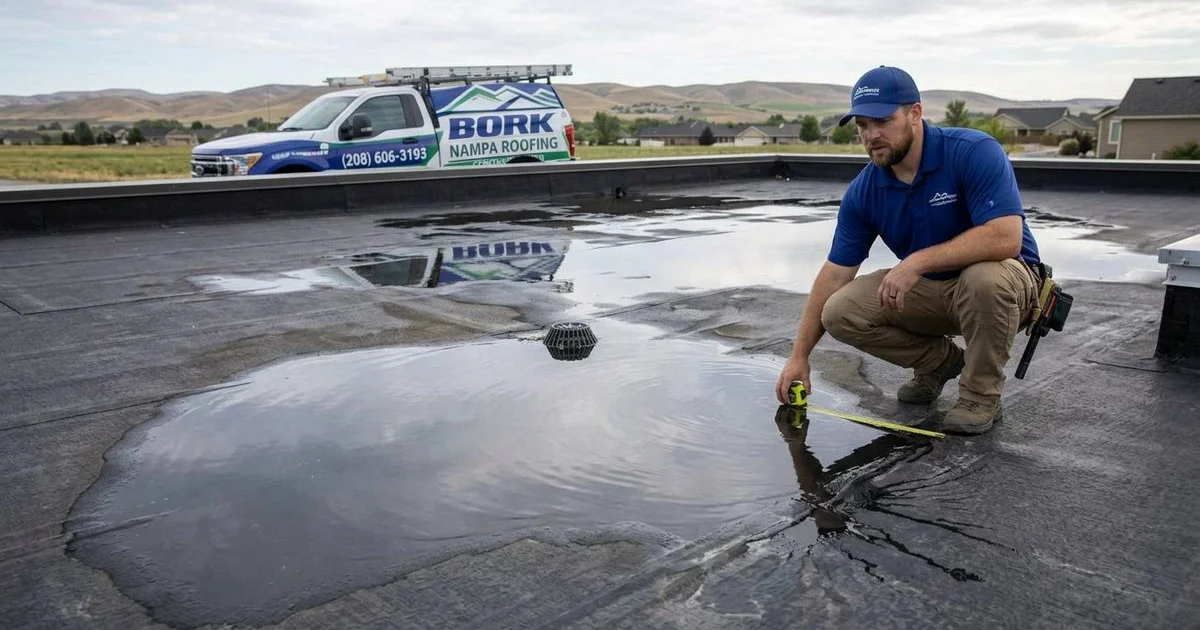
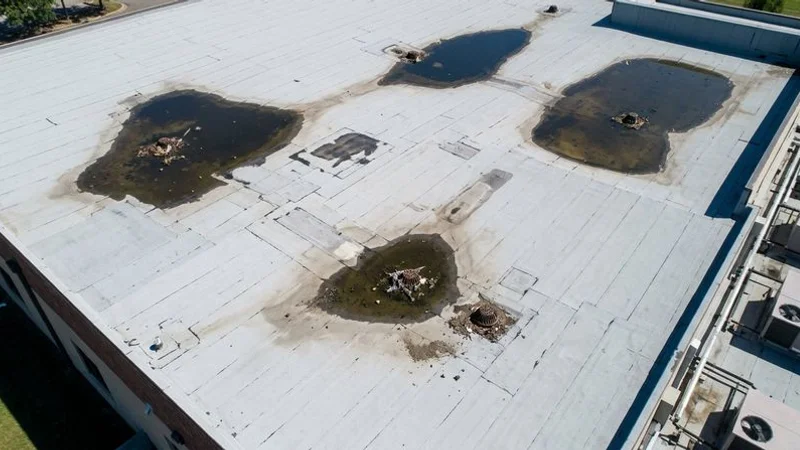
You know that sinking feeling when you walk onto a roof days after a storm and still see large puddles reflecting the sky? That is not just a drainage quirk. In our industry, we call it “ponding water,” and it is defined by the National Roofing Contractors Association (NRCA) as water that remains on a roof for more than 48 hours after rainfall.
We see this constantly on commercial buildings in Nampa and throughout the Treasure Valley. While a thin film of water that evaporates in 24 hours is generally acceptable, deep standing water is a distinct threat to your building’s longevity. It accelerates membrane breakdown, adds massive weight, and voids warranties.
Our team has inspected hundreds of roofs where this “harmless” water caused tens of thousands of dollars in avoidable damage. Understanding the specific mechanics of this problem is the first step toward fixing it before a leak destroys your inventory.
The Real Risks of Ignoring Ponding Water
Standing water creates a compound effect that attacks your building from multiple angles simultaneously. The following risks are not theoretical; they are the documented consequences we see in the field every week.
Structural Load Increases Dangerously
Water is deceptively heavy. A single inch of water weighs approximately 5.2 pounds per square foot. That might sound manageable until you do the math for a larger area. On a 1,000-square-foot section of roof, one inch of standing water adds roughly 5,200 pounds of dead load.
We often remind building owners that this is equivalent to parking a heavy-duty pickup truck on a roof that may not be engineered for it. As the roof deck sags under this weight, it creates a deeper bowl, which collects more water and adds more weight. This cycle, known as “deflection,” can lead to permanent structural deformation or collapse in extreme cases.
Idaho Winters Make It Worse
In our region, the freeze-thaw cycle turns ponding water into a physical weapon against your roof. When water freezes, it expands by approximately 9% in volume. If that water has seeped into micro-cracks in your membrane or flashings, the expansion forces those cracks open wider.
Our crews frequently repair damage where winter ice has literally torn seams apart. What starts as a minor low spot in July becomes a major ice dam issue by January, often backing water up under flashings where it causes interior leaks.
Warranties Get Voided
You might assume your 20-year manufacturer warranty covers leaks from standing water, but that is rarely the case. Most standard commercial roofing warranties specifically exclude damage resulting from ponding water. Major manufacturers like Carlisle and GAF often require positive drainage—meaning the roof is dry within 48 hours—to maintain full coverage.
We have seen claims denied because the owner could not prove they addressed known drainage issues. unless you have a specific “No Dollar Limit” (NDL) warranty with a ponding rider, you are likely self-insuring against this specific risk.
Membrane Deterioration Accelerates
Roofing membranes like TPO and EPDM are designed to shed water, not to be submerged. Standing water acts like a magnifying glass for UV rays, intensifying the solar radiation that breaks down the chemical bonds in the membrane.
Our inspections often reveal that the membrane in a ponding area is chalky, brittle, or cracking years before the rest of the roof shows age. This premature failure creates a weak point where water will eventually find a way into the insulation and decking below.
What Causes Ponding Water on Flat Roofs?
Ponding is rarely a mystery; it is usually the result of physics and design. Identifying the root cause is critical because treating the symptom without fixing the source is a waste of money.
Poor Original Drainage Design
Building codes are clear on this requirement. The International Building Code (IBC) Section 1507.10.1 mandates a minimum slope of one-quarter unit vertical in 12 units horizontal (a 2% slope) for most membrane roofs.
We find that many older buildings in Canyon County were built with insufficient slope or lack “crickets”—the triangular diversion structures that guide water between drains. Without these critical design elements, water naturally settles in the flat spots between drain sumps.
Compressed or Saturated Insulation
Roof insulation boards are rigid, but they can be crushed. Frequent foot traffic to service HVAC units often compresses the insulation creates a walking path that becomes a water trough.
Our thermal scans frequently show that once insulation gets wet from a small leak, it loses its structural integrity and compresses further. This creates a depression that holds more water, which feeds the leak, saturating more insulation. It is a self-destructing loop that spreads damage across the roof deck.
Clogged or Undersized Drains
Even a perfectly sloped roof will flood if the drain is blocked. In Idaho, we battle wind-blown debris like tumbleweeds, cottonwood seeds, and construction dust.
We typically find that a clogged strainer basket is the single most common cause of temporary ponding. If the drain is clear but the water still ponds, the plumbing pipes themselves may be undersized for the square footage of the roof they serve.
Structural Deck Deflection
All buildings settle over time. A concrete or steel deck can permanently sag between support beams due to “creep” (long-term deformation under load). This settling changes the drainage patterns originally designed by the architect.
Our assessments often identify these low spots near heavy rooftop units where the added weight has caused the deck to bow slightly. This redirects water away from drains and into new, unplanned ponds.
How to Fix Ponding Water: Proven Solutions
The right repair depends on your budget, the roof’s condition, and your long-term plans for the building. We have compiled this comparison of the most effective solutions we use, based on 2026 industry standards and material costs.
Comparison of Ponding Water Solutions
| Solution | Best For | Est. Cost Impact | Longevity |
|---|---|---|---|
| Drain Cleaning | Clogged drains | Low ($) | Short-term |
| High-Solids Silicone | Minor ponding / Aging roofs | Medium ($$) | 10-20 Years |
| New Interior Drains | localized low spots | Medium-High ($$$) | Permanent |
| Tapered Insulation | Widespread drainage issues | High ($$$$) | Permanent |
Solution 1: Clear and Upgrade Drainage
This is your first and most affordable line of defense. We always begin by verifying that the existing system is actually working. Cleaning strainer baskets, snaking drain lines, and removing debris from scuppers can solve a surprising number of “failure” cases.
If the drains are clear but overwhelmed, we can sometimes retrofit larger drain bowls or add “retro-drains” that seal into the existing pipe. This improves flow rate without the massive expense of ripping up the roof.
Solution 2: Install Tapered Insulation
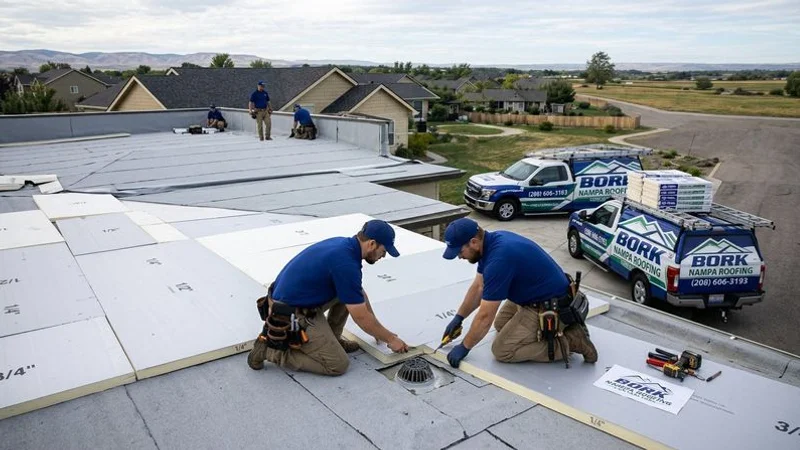
This is the gold standard for correcting poor slope. A tapered insulation system consists of pre-cut insulation boards that snap together like a puzzle to create a new, artificial slope on top of your flat deck.
We recommend this solution when re-roofing because it physically eliminates the possibility of standing water. While it adds approximately $4.00 to $6.00 per square foot to a project (based on current 2026 estimates), it pays for itself by extending the roof’s life and improving thermal efficiency for our hot summers and cold winters.
Solution 3: Apply High-Solids Silicone Coatings
Not all roof coatings are created equal. For areas with ponding water, acrylic coatings will re-emulsify and wash away. You need a “high-solids” silicone coating, which is moisture-cured and does not break down under standing water.
Our team uses silicone to restore roofs where the membrane is intact but the slope is imperfect. The silicone creates a seamless, waterproof barrier that resists the biological growth and UV damage associated with ponding. It is an excellent mid-term solution that costs significantly less than a full tear-off.
Solution 4: Add Interior Drains or Scuppers
Sometimes the water just has nowhere to go. Installing new drains involves cutting through the roof deck and plumbing new lines into the building’s storm water system.
We often install new scuppers (openings in the parapet walls) as emergency overflows. If your primary drains clog, these scuppers provide a safety valve that prevents water weight from reaching critical levels. This is a targeted structural modification that solves specific problem areas.
Prevention Saves Thousands
The most effective way to handle ponding water is to stop it from becoming a chronic issue. A proactive maintenance plan is far cheaper than an emergency roof replacement.
We recommend a specific protocol for our commercial clients in the Treasure Valley:
- Implement the “10-Foot Circle” Rule: Keep a 10-foot radius around every drain completely clear of vegetation and debris.
- Schedule Spring and Fall Inspections: Check for winter freeze damage in March and clear falling leaves in November.
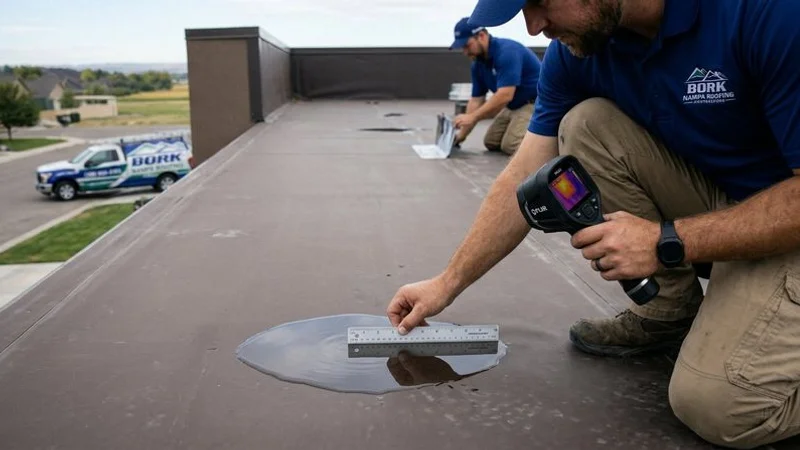
- Monitor Water Depth: Use a tape measure to document water depth 48 hours after rain. If it increases over time, your structure may be settling.
- Check HVAC Panels: Ensure service technicians are not leaving loose screws or panels that can wash into and clog drains.
Tracking these metrics gives you the data you need to make smart capital expenditure decisions.
Get Your Flat Roof Assessed by Professionals
If you see water sitting on your roof three days after a storm, that is a red flag you cannot afford to ignore. The structural risk and warranty implications are too high. Bork Nampa Roofing Contractors specializes in diagnosing and correcting complex commercial roofing drainage issues.
We provide comprehensive assessments that identify the exact cause of your ponding—whether it is a simple clog or a structural slope failure. Our goal is to give you the honest data you need to choose the most cost-effective solution for your business.
Call us at (208) 606-3193 to schedule your free assessment, or request your consultation online. We serve building owners in Nampa, Meridian, Caldwell, and the surrounding areas.

Bork Roofing Team
Licensed Roofing Contractor
Licensed roofing contractors serving Nampa and the Treasure Valley.